
Champagne Kisses
Every quilt has a moment where it quietly tells you what it wants to be. Sometimes that happens before you’ve even cut into the fabric. You have a clear picture in your mind, a shopping list, perhaps even a name. Other quilts take a little more convincing. They begin as an interesting block, or a colour combination you’d like to explore, and gradually gather momentum until you realise you’re no longer making a sample. You’re making a quilt.
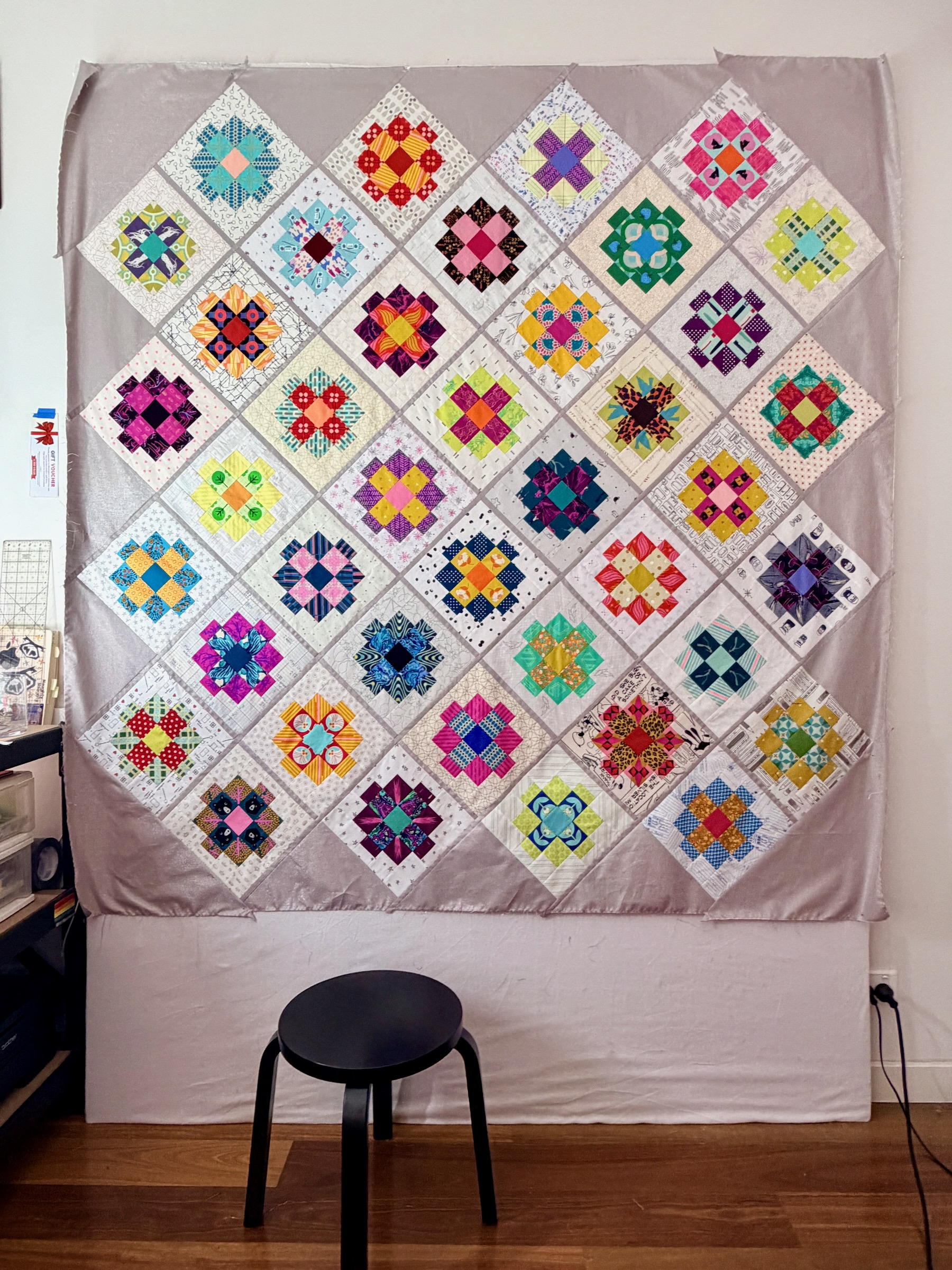
Champagne Kisses belonged firmly in the second camp. It began with one of geometriquilt’s Sunday Sketch blocks, which immediately appealed to the part of my brain that enjoys seeing how many different personalities can emerge from the same basic geometry. I made one block, then another, then another. Each time I finished pressing the seams I’d find myself wondering, “What if I tried that fabric instead?” or “What happens if I rotate this print?” Before long I’d stopped making blocks and started conducting little experiments.
The obvious thing would have been to pull a fabric collection and work within its boundaries. That would certainly have produced a lovely quilt, but it wouldn’t have kept my attention for very long. I’ve discovered over the years that I’m much happier when fabrics are allowed to surprise me. So I wandered over to the Cupboard of Love, opened the doors and simply started looking. Not looking for anything in particular, just looking. That’s one of my favourite things about storing fabric wrapped around comic book boards. I can see every print at once. Nothing is buried at the bottom of a tub or forgotten behind three newer purchases. It’s a cupboard full of possibilities rather than a cupboard full of obligations.
I know “shopping your stash” has become one of those phrases quilters use almost as a badge of honour, but I’ve never thought about my fabric that way. It makes the cupboard sound like a problem that needs solving before you’re allowed to buy something else. Mine has never felt like that. Every piece in there is something that made me stop and smile at some point over the last fourteen years. Some were bought because of a colour. Others because of a tiny detail hidden in the print. Some because I couldn’t imagine ever needing them but couldn’t bear to leave them behind. They all deserved to wait until the right quilt came along rather than being used simply because they’d been on the shelf the longest.
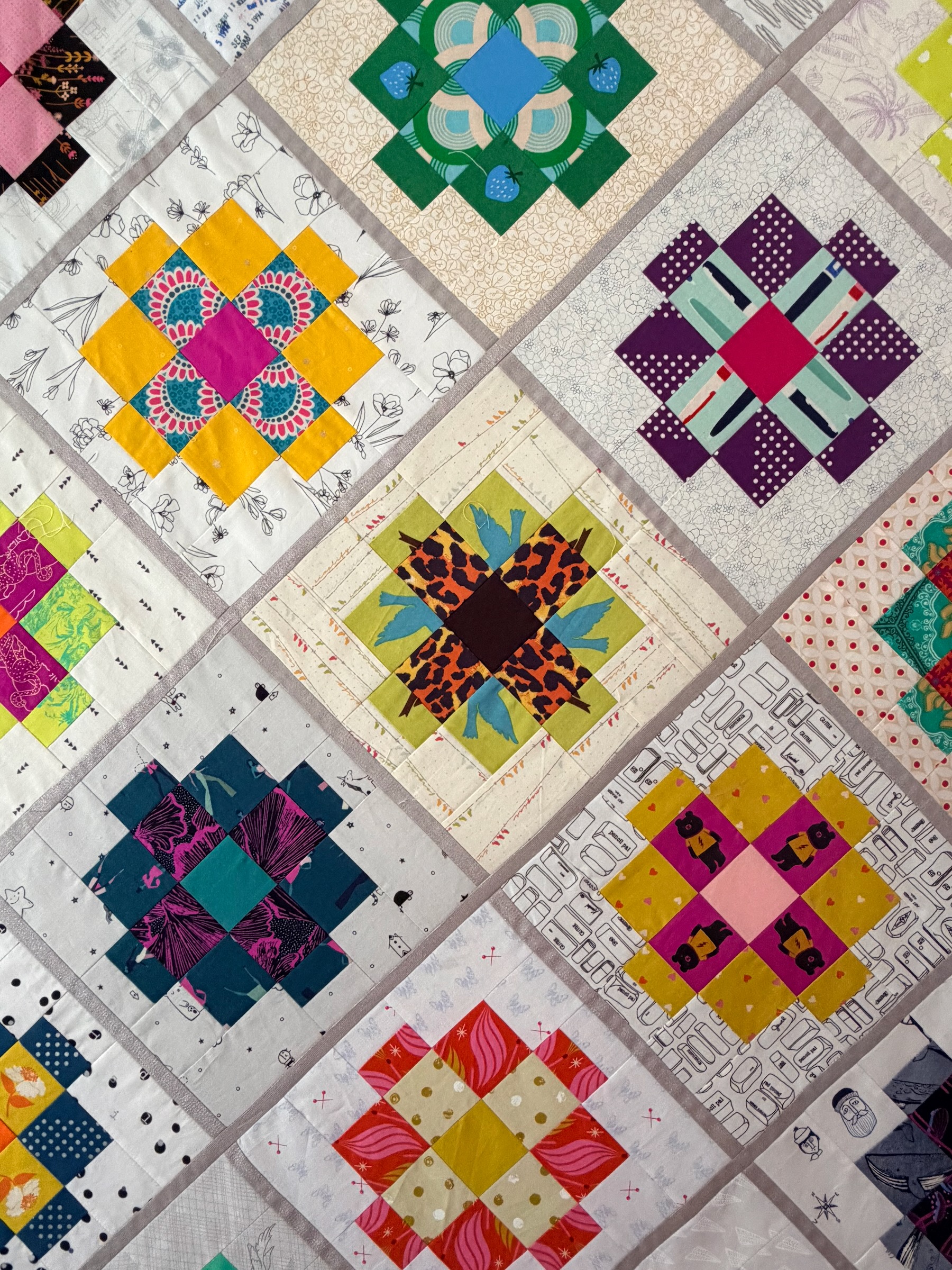
That’s exactly what happened here. Heather Givans’ Literary prints ended up beside Libs Elliott stripes. Ruby Star Society fabrics found themselves chatting away with Alison Glass. Old Cotton + Steel prints, scraps of Pat Bravo’s Carnaby Street, a steadily expanding collection of cheetah prints and all sorts of little treasures I’d almost forgotten about began finding partners they were never designed to have. Once the rotary cutter arrived, the collections disappeared. They were no longer fabrics by different designers from different decades. They were simply shapes, colours and little pieces of possibility waiting to see who they’d sit beside.
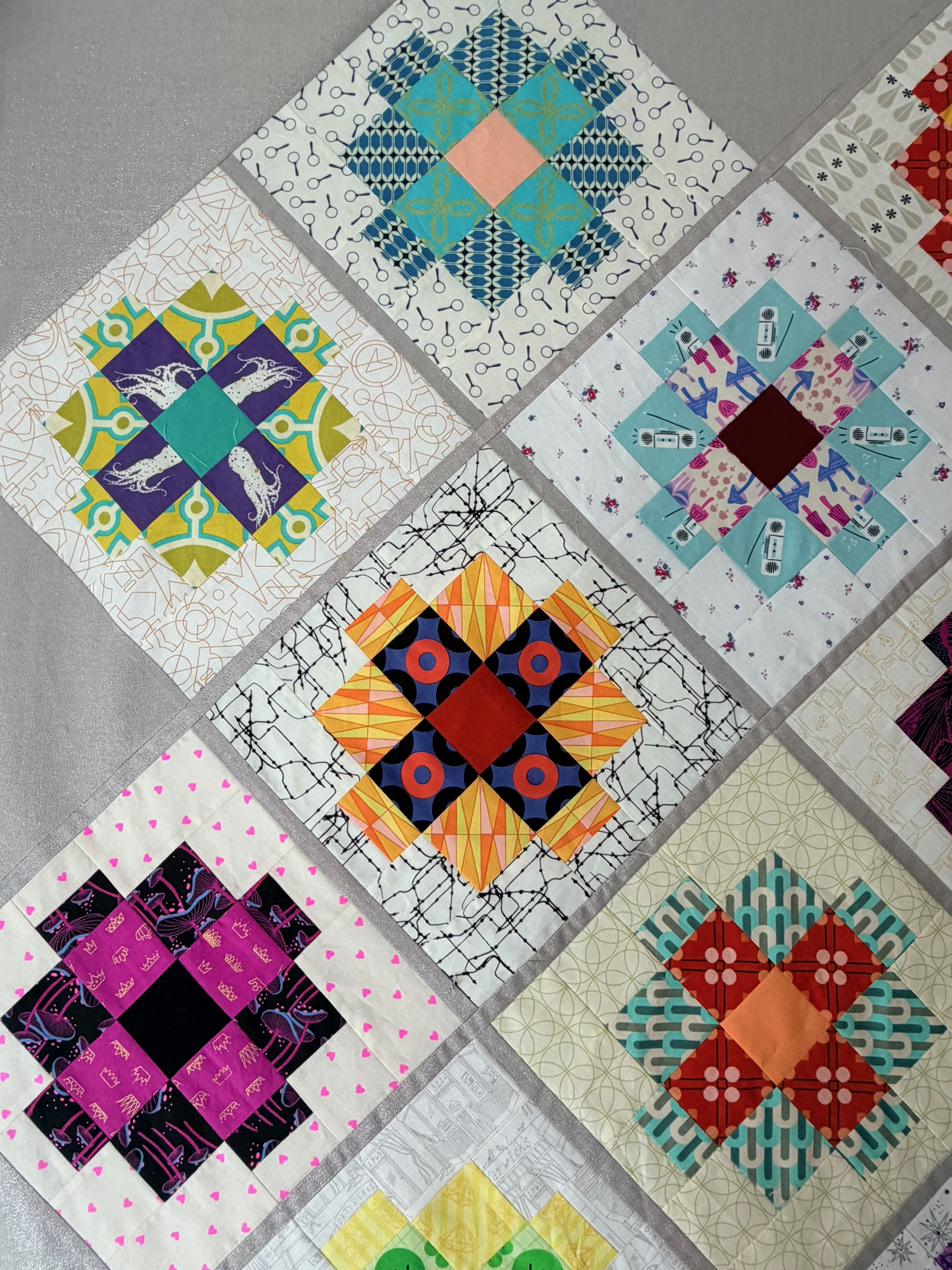
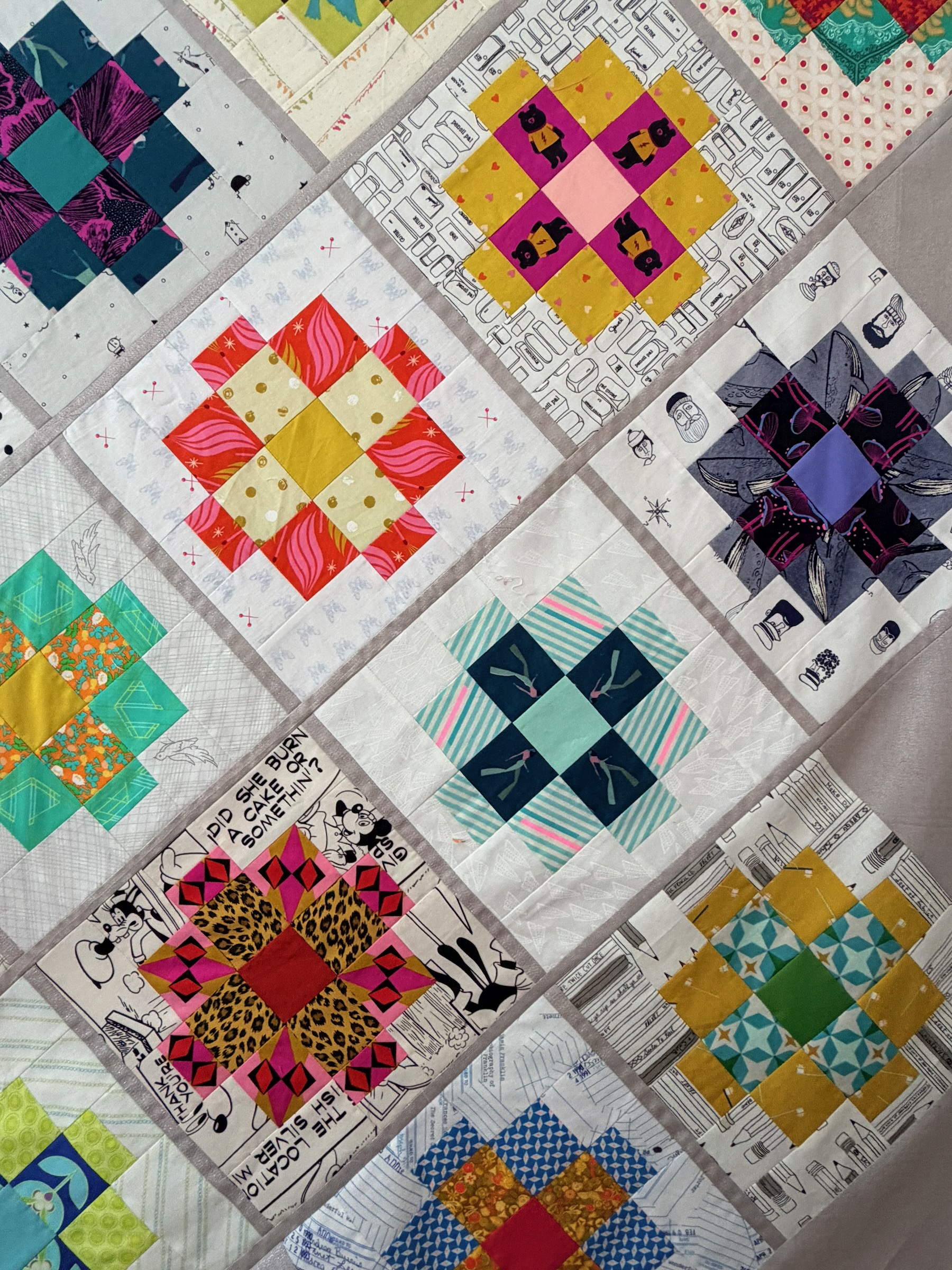
It wasn’t until I started fussy cutting that the quilt really came alive. I’ve always enjoyed looking for motifs hidden inside a print, but this quilt had me seeing fabrics I’d owned for years with completely fresh eyes. A MoMo print I’d always thought of as birds suddenly became flowers once I chopped all their heads off. Octopus tentacles turned into iris petals. Goldfish tails became camellias. Boomboxes found themselves orbiting mushrooms as though they’d always belonged together. Every block became a tiny puzzle asking the same question: “What else can this fabric be?”
Originally I had every intention of setting the blocks in straight rows. That’s how I’d been designing them all along, and it seemed the most sensible thing to do. Then, almost absent-mindedly, I pinned a handful onto the design wall on point. It wasn’t part of some grand design plan; I was simply curious. Quilts have a habit of rewarding curiosity, and this one was no exception. The moment those blocks rotated, the whole quilt seemed to wake up. The movement that had been happening inside each individual block suddenly flowed across the entire quilt. Your eye no longer travelled politely from left to right. It wandered. It circled back. It discovered little moments you’d missed the first time around.
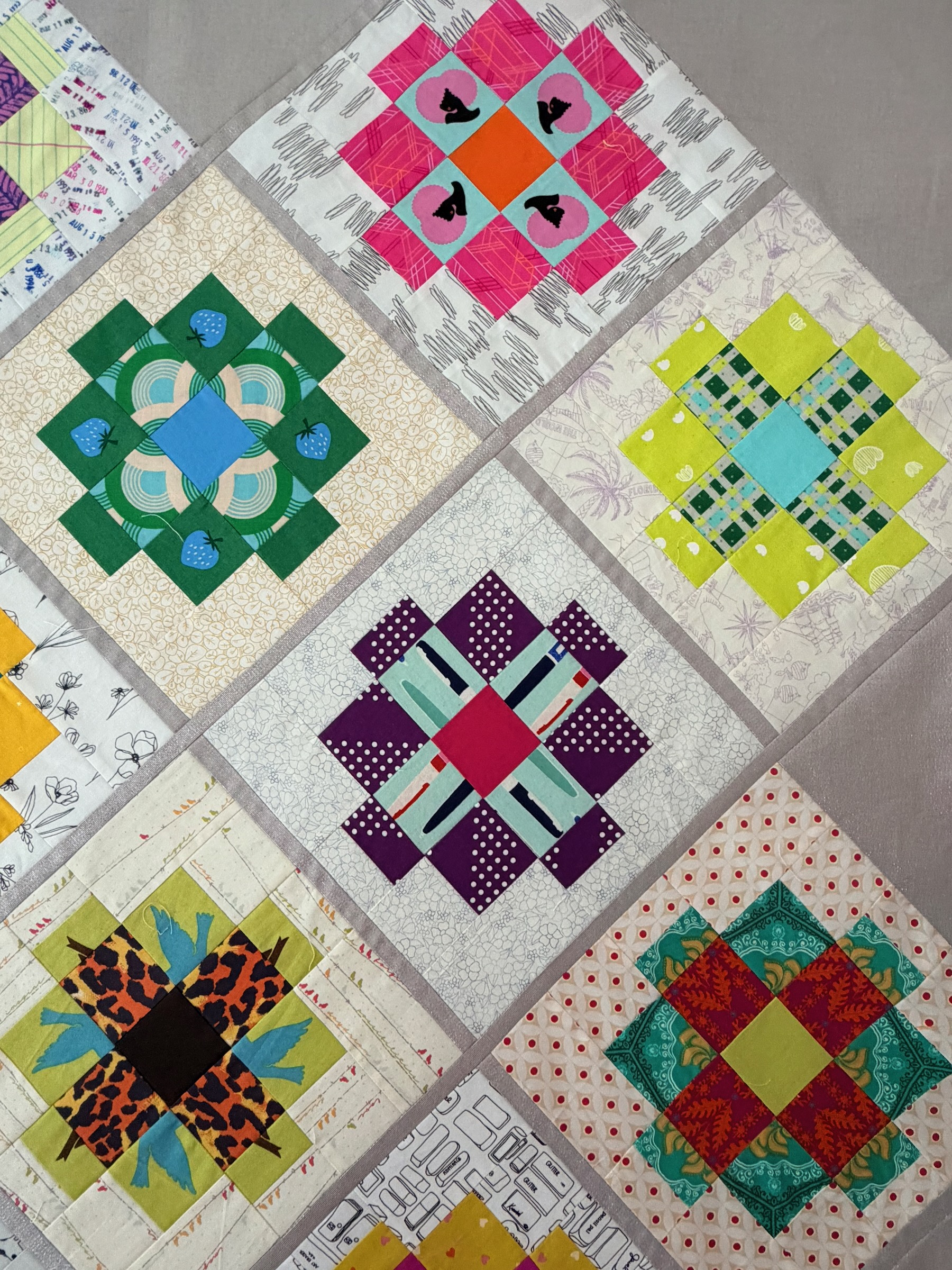
There was another advantage, although I’d be lying if I said I’d planned it. By this stage I’d made forty blocks and, quite honestly, forty felt right. I wasn’t tired of the block, but I also didn’t feel compelled to make another twenty. I’d explored the idea as far as I wanted to. Setting the quilt on point transformed those forty blocks into a generous seventy-five inch square quilt, which is just about my favourite size for curling up on the couch. Sometimes the prettiest design decision also turns out to be the most practical, and I have absolutely no objection to that.
The next puzzle was the sashing. Every option seemed wrong for a different reason. Without any sashing the blocks blended into one another and lost some of their individuality. A scrappy low-volume sashing only added to the visual noise because every block already contained its own low-volume background. Choosing a single white was even worse. Some blocks leaned towards crisp white, others towards warm cream, and many of the backgrounds carried tiny prints of their own. Every fabric I auditioned seemed to make one group of blocks happy while upsetting another.
Eventually I did what I usually do when I can’t solve a problem. I went back to the cupboard.
Hidden in plain sight was a soft grey Lurex. I’d yet to find the right project for it because it always seemed too subtle to be the star of the show, but that was exactly why it worked here. It shimmered quietly. It tied together all those different shades of white without trying to compete with them, and somehow it felt entirely appropriate that a fabric with a little sparkle should find its way into a quilt made by someone called Molli Sparkles. The sashing is only half an inch wide because I wasn’t trying to separate the blocks. I simply wanted to give each one enough breathing room to be appreciated before introducing the next. Looking at the finished quilt now, I think that’s exactly what the grey does. It behaves less like sashing and more like the wall space between paintings in a gallery.
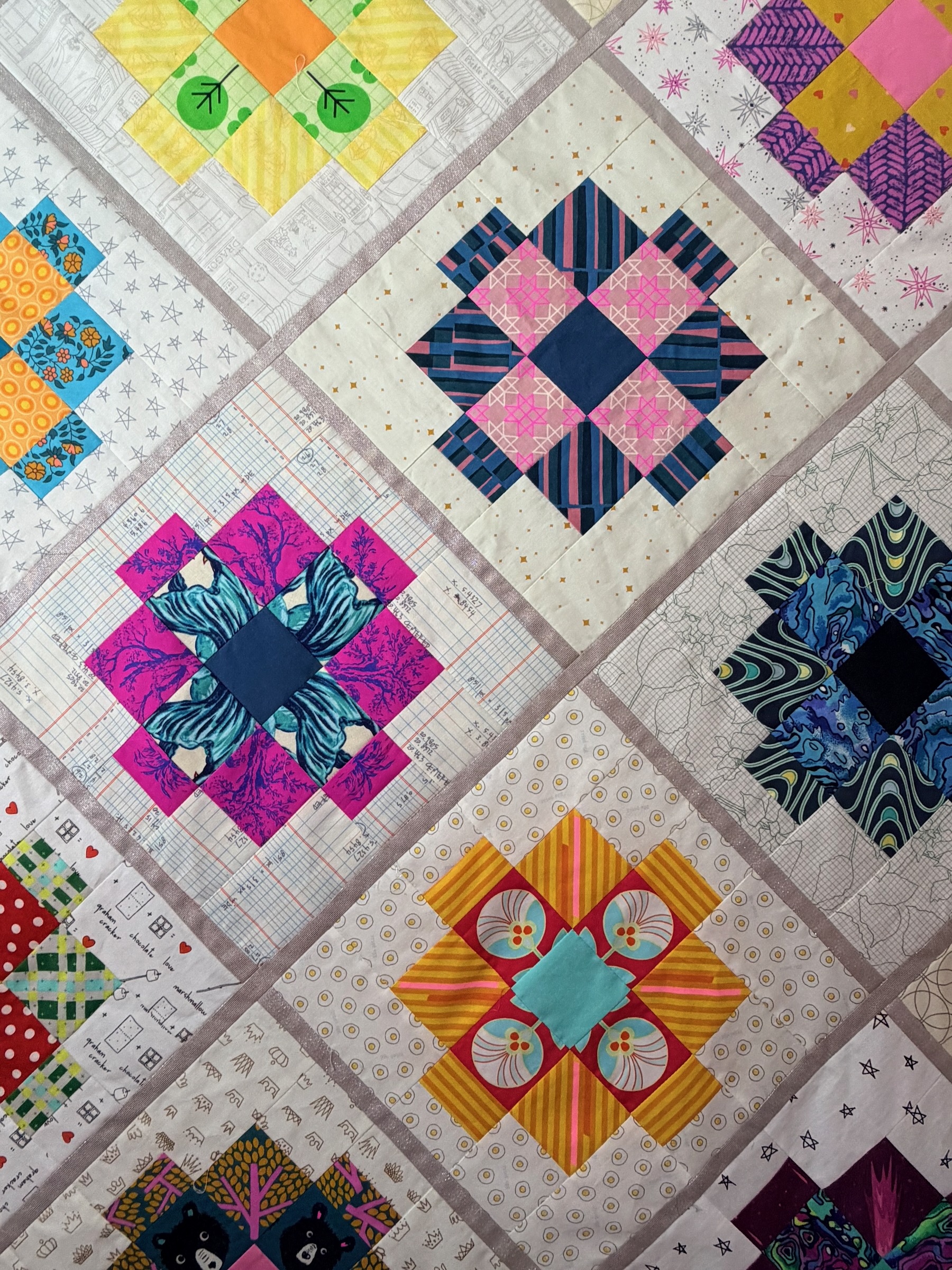
One thing I did pay attention to was the setting triangles. If you’ve ever wondered why some quilts seem determined to grow while you’re quilting them, bias edges usually have something to do with it. Whenever I can, I cut my setting triangles so the outside edge of the quilt sits on the straight grain rather than the bias. I also cut them slightly oversized because I’ve yet to meet a quilter who regretted having a little extra fabric to trim away. You can always trim back. The reverse has yet to be invented.
Laying out the finished blocks looked wonderfully organised from a distance and anything but organised from where I was standing. There wasn’t a spreadsheet. There wasn’t a carefully drawn map. There was just me, a design wall and an unreasonable amount of walking backwards. Every low-volume background appears only once. Most feature fabrics appear no more than twice, and never in the same position within the block. Beyond that, I simply kept moving things until the quilt felt balanced. If two fabrics started shouting over one another, one of them had to move. If my eye kept getting stuck in one corner, something needed changing. Eventually there comes a point where every adjustment makes the quilt worse rather than better. That’s usually how I know it’s time to stop.
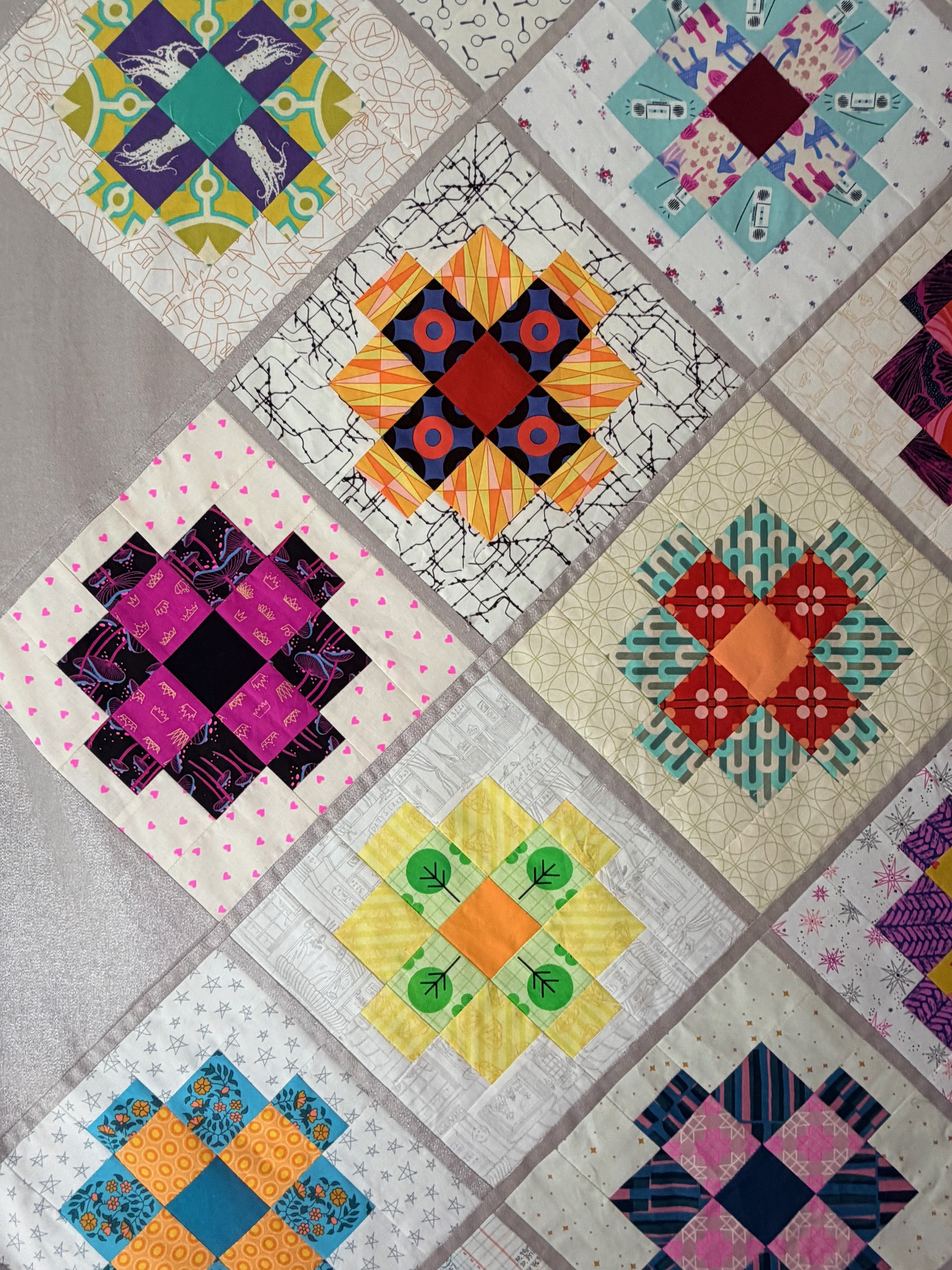
Looking at Champagne Kisses now, I don’t really think about the block anymore. I think about all the fabrics I’d been looking at for years without really seeing. Not because they’d changed, but because I had. Somewhere along the way I’d stopped thinking about collections and started thinking about relationships instead. Colour beside colour. Shape beside shape. Tiny fragments of prints designed years apart finding unexpected ways to complete one another.
I know some people look at a fabric cupboard and see a backlog of projects waiting to be finished. I’ve never felt that. Mine has always been more like a conversation that’s waiting for the right question. Every fabric is there because something about it caught my attention, and I’ve learnt not to rush that instinct. Sometimes the answer appears the following weekend. Sometimes it takes a decade. This quilt reminded me that there isn’t a right timetable for creativity. There is only the quiet satisfaction of recognising, after all those years, that a fabric has finally found exactly where it belongs.
When I stand in front of Champagne Kisses now, that’s what makes me smile the most. Yes, I see the geometry. I notice the movement, the sparkle and all those tiny moments of fussy cutting hidden throughout the quilt. But more than anything, I see a cupboard full of fabrics that waited patiently until they found each other. And, as it turns out, they were worth the wait.
Perhaps the hardest part is still to come.
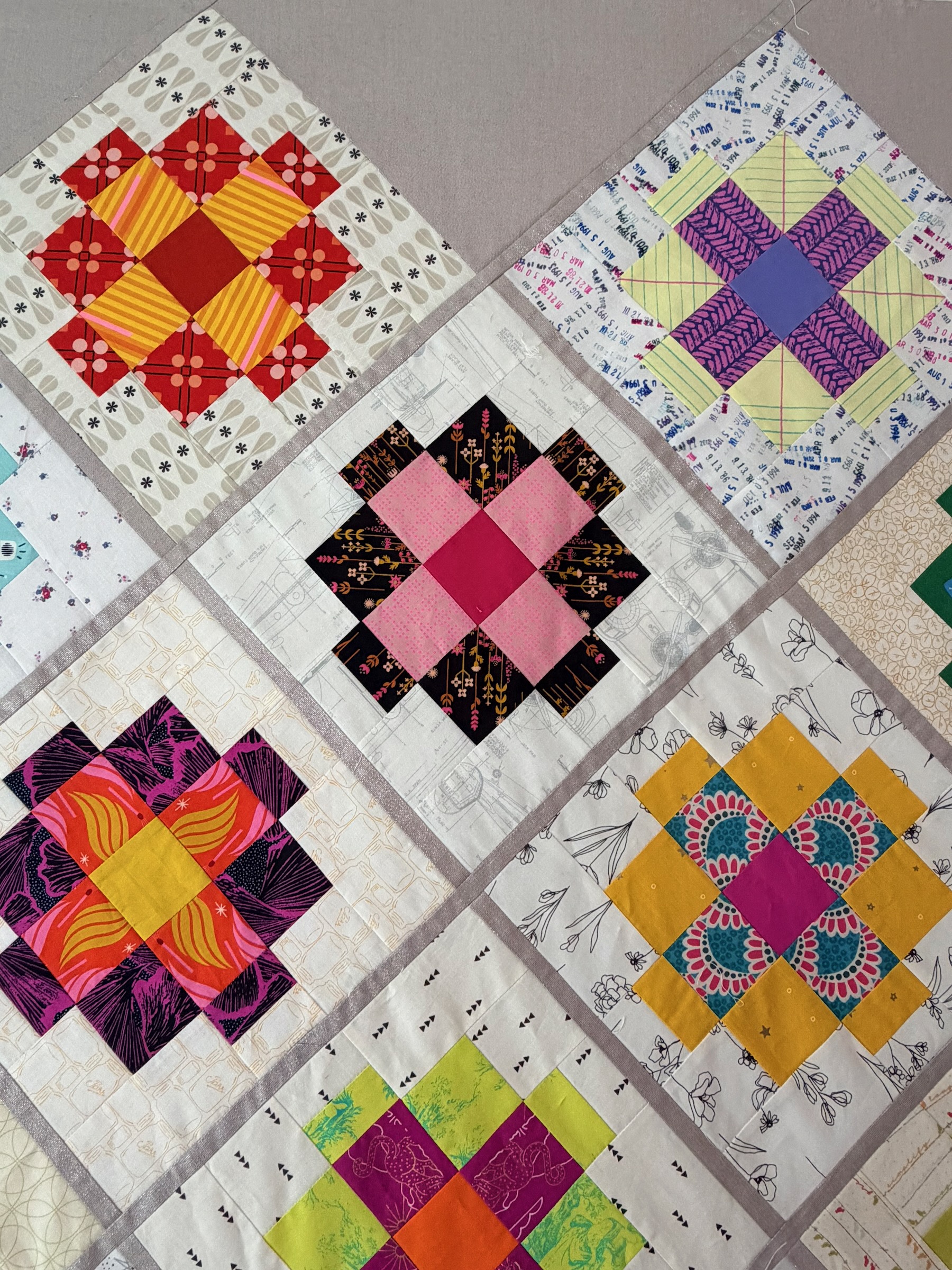
At the moment Champagne Kisses is only a quilt top, which means I’ve solved one creative puzzle and immediately inherited another. How on earth do I quilt it? Do I echo all that movement with equally energetic quilting? Do I let the piecing do all the talking and keep the quilting quiet? I genuinely haven’t decided yet, and experience has taught me not to rush that decision. This quilt has spent years waiting for the right fabrics to find one another; it can wait a little longer while I work out the right quilting design. Once it’s quilted, bound and finally finished, I’ll be back to share photographs of the completed quilt. Somehow I suspect Champagne Kisses still has a few more surprises left to reveal.



You so beautifully word the relationship I have with my stash too and how I combine my fabric combinations. Thank you for the words and, of course, sharing another dazzling quilt and its journey into the world. X
Have you seen Lucy Boston’s Patchwork of the Crosses quilt… fussy cutting before it had been invented. An amazing woman too! Your quilt top reminded me so much of that process…
Gorgeous. I also agree about the fabrics that we have, just waiting for the right moment. I love opening my plastic boxes and looking and feasting my eyes.
I’m so glad to get an update! I really enjoyed looking at this quilt, and feel like my “Oh, look at that!” and “Isn’t that a cool!” were right on target with what you wrote. I do like the movement created. Thanks for sharing!!
I’ve mostly been working on quilts from donated materials (so quite random), which are then donated in turn. They definitely need to be functional, but it is nice when they can also feel… intentional? (Maybe that’s the right word…) So again this post speaks to that. Thanks!
Oh my goodness!!! Molli!!! I just love this so much!! At present my stash is in a container on a ship! I can’t wait for it to get here!! Inspirational stuff (as always)!
It is so relaxing and meditative to play with fabrics and set them side by side until you are happy with the choices. Grey fabrics are always a conundrum with so many base colours (blue, yellow, green, beige) which can make a specific grey look *just wrong* beside other fabrics. I celebrate with you the joy you had with this quilt. Looking forward to seeing the quilting choice.
WOW Thanks as always for brightening my day (which today is tornado warnings and touchdown in the next town) LOVE this and thanks for using all the white on white on gray on and on…… I have an entire shelf and you have given me the visual I needed to see how this works. Thanks ass always for the news I can use! Hope all is well with you and yours.
Not only is the quilt once again another stunner…your writing and the story you tell warms my heart! You’re a masterful storyteller!